Date: 13 - 17 April 2009

![]()
Venue: National University of Ireland, Galway
In Collaboration: DHO, Moore Institute, IRCHSS
Co-Directed by Dr Susan Schreibman and Professor Sean Ryder
The DHO and the Moore Institute were delighted to host a week-long spring school on the topic of digital scholarly editing. This event, the first of its kind in Ireland, provided Irish researchers the opportunity to engage with cutting edge theories, methods, and technologies through a mixture of specialised workshops, masterclasses, and project consultations. Workshop tracks catered to a wide range of participants from the complete novice to those who have some experience in digital scholarly editing.
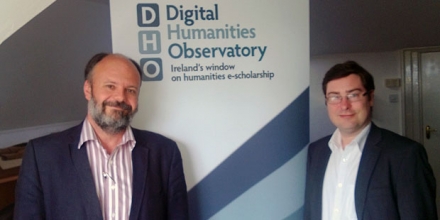
Pictures from the event can be found in the Spring School Image Gallery.
Contents
Introduction
Morning lectures and afternoon master classes were given by international experts in addition to three workshop strands. Two of the strands focused on specific areas of text encoding: TEI Encoding for Digital Scholarly Editions of Printed Texts, and Encoding Manuscripts and Other Handwritten Materials. The third strand provided a general overview for those with no experience, aptly titled An Absolute Beginner's Introduction to the TEI for Scholarly Editions.
Participants had many opportunities to interact with teaching staff both formally and informally, as well as exchange knowledge across projects enabling the building of networks that are vital for this kind of multi-disciplinary and team-based research.
This event was generously funded with a grant from the Irish Research Council for the Humanities and the Social Sciences (IRCHSS).
Programme
All participants attended morning lectures and had a choice of an afternoon master class. Information on workshop tracks are detailed under the subheading Workshop Tracks.
| Monday | Tuesday | Wednesday | Thursday | Friday | |
|---|---|---|---|---|---|
|
|
|||||
| Morning Lectures | |||||
| 9:00 - 10:00 |
Sean Ryder: Introduction & Susan Schreibman: A New Model for Scholarly Editions | John Lavagnino: Experiences of the Previous Generation: The Thomas Middleton Edition | John Bryant: Visions and Versions: Editing Melville / Editing Kerouac | Fotis Jannidis: TextGrid - A Dynamic Virtual Environment for Editing Online Editions | Edward Vanhoutte: Theories and Technologies of Digital Scholarly Editing |
| 10:00 - 11:00 |
Editing Tracks | Editing Tracks | Editing Tracks | Editing Tracks | Editing Tracks |
| 11:00 - 11:30 |
Coffee | Coffee | Coffee | Coffee | Coffee |
| 11:30 - 13:30 |
Editing Tracks | Editing Tracks | Editing Tracks | Editing Tracks | Editing Tracks |
| 13:30 - 14:30 |
Lunch | Lunch | Lunch | Lunch | Lunch |
| Master Classes | |||||
| 14:30 - 17:30 |
Dino Buzzetti: Processing the Edition or John Bryant: Imagining the Fluid Text: Versions, Editing, Ethics | Ken Price: Annotation and Contextualization of Letters or Fotis Jannidis: Online Genetic Editions: The Philosophy Behind It, the Tools to Create Them | Open Lab and Project Consultation | Edward Vanhoutte: Editing Correspondence or Susan Schreibman/Sean Ryder: The Idea of an Irish Digital Scholarly Imprint | Wrap up Panel Discussion*: New Directions and Next Steps |
| 17:30 - 19:00 |
Welcome Reception | ||||
Workshop Tracks
- An Absolute Beginner's Introduction to the TEI for Scholarly Editions
- TEI Encoding for Digital Scholarly Editions of Printed Texts
- Encoding Manuscripts and Other Handwritten Materials
An Absolute Beginner's Introduction to the TEI for Scholarly Editions
James Cummings (University of Oxford) and Justin Tonra (Moore Institute, NUIG)
This workshop is intended for absolute beginners, most likely with no experience of textual markup of any sort, who want an introduction to the Text Encoding Initiative Guidelines (TEI). Very basic computer literacy (email, word processing) will be assumed. The course will provide an introduction to the concept of markup in the production of scholarly digital editions. It will teach the basics of encoding in XML (Extensible Markup Language) and a general overview of the TEI Guidelines. Introductory lectures and demonstrations surveying a wide range of TEI modules will be balanced by practical exercises following step-by-step instructions intended to familiarise attendees with the basic techniques of creating an electronic scholarly XML-encoded text. While this course will provide a survey of the TEI Guidelines, specific recommendations will be treated in less depth than in the other, more specialized, workshops.
Required reading:
- 'Guidelines for Editors of Scholarly Editions' from the Modern Language Association's Committee on Scholarly Editions in _Electronic Textual Editing_ ed. Lou Burnard, et al., MLA, 2006.
- TEI P5 Guidelines: 'v. A Gentle Introduction to XML', TEI Consortium, 2007.
Optional reading:
- Cummings, James 'The Text Encoding Initiative and the Study of Literature' in A Companion to Digital Literary Studies, ed. Susan Schreibman and Ray Siemens. Oxford: Blackwell, 2008.
- Sperberg-McQueen, C. M. 'Textual Criticism and the Text Encoding Initiative' at MLA, San Diego, December 1994.
- Buzzetti, Dino and McGann, Jerome. 'Critical Editing in a Digital Horizon' in _Electronic Textual Editing_ ed Lou Burnard, et al., MLA, 2006.
TEI Encoding for Digital Scholarly Editions of Printed Texts
Paul Caton (National University of Ireland, Galway) and John Lavagnino (King's College London)
This workshop focuses on creating scholarly digital editions of printed documents. Participants will become familiar with the various means the Text Encoding Initiative markup scheme offers to create editions of different kinds, including facsimile editions, diplomatic transcriptions, and eclectic editions. Specific topics will include coordinating images and text, recording textual variants, and dealing with correction and normalization. Techniques for controlling online display and functionality on the basis of the underlying encoding will be discussed at a general level, but the stress will be on the scholarly encoding activity that provides the basis for an edition. No programing knowledge is required, but it is expected that participants will be familiar with traditional scholarly editing concepts and know at least the fundamentals of XML and text encoding.
Reading list
Required reading:
- Price, Kenneth (2008). "Electronic Scholarly Editions," in A Companion to Digital Literary Studies, ed. Susan Schreibman and Ray Siemens. Oxford: Blackwell, 2008.
- Smith, Martha Nell (2004). "Electronic Scholarly Editing." In Susan Schreibman, Ray Siemens, and John Unsworth (Eds.). A Companion to Digital Humanities. Oxford: Blackwell, 2004.
Optional reading:
- Burnard, Lou, Katherine O'Brien O'Keeffe, and John Unsworth, eds. (2006). Electronic Textual Editing. Modern Language Association
- TEI Consortium, eds. TEI P5: Guidelines for Electronic Text Encoding and Interchange. Version 1.2.0. October 31st 2008. TEI Consortium. .
- Women Writers Project Guide to Scholarly Encoding.
Workshop Materials
All the materials used in the workshop are available at http://tei.oucs.ox.ac.uk/
Encoding Manuscripts and Other Handwritten Materials
Dot Porter (Digital Humanities Observatory) and Malte Rehbein (National University of Ireland, Galway)
This course will provide an introduction to the theory and practice of encoding and transforming handwritten materials, including classical, medieval, early modern, and modern texts. It is designed for individuals embarking on a text encoding project of non-print materials, and who would like a better understanding of the philosophy, theory, and practicalities of encoding in XML (Extensible Markup Language) using the Text Encoding Initiative (TEI) guidelines. Topics covered will include
- Representing primary sources in encoding
- Describing manuscripts and other text-bearing objects
- Critical apparatus and variant readings
- Linking between text and image, description and image, and text and description
- EpiDoc: a TEI extension for epigraphic transcription
Equal focus will be given to methods for displaying, visualizing, and using encoded texts. Students will also receive instruction on specifying their own document encoding rules using schemas. Existing knowledge of XML and the TEI is required, and students will be expected to have attended an introductory XML/TEI course previously.
TEI Chapters:
Other:
- Matthew Driscoll, "Levels of Transcription," Kevin Kiernan, "Digital Facsimiles in Editing" Edward Vanhoutte, "Prose Fiction and Modern Manuscripts: Limitations and Possibilities of Text-Encoding for Electronic Editions"
Workshop Materials
All the materials used in the workshop are available for download at download [Zip 18.6Mb]
Masterclasses
- Annotation and Contextualization of Letters
- Editing Correspondence
- Imagining the Fluid Text: Versions, Editing, Ethics
- Online Genetic Editions: The Philosophy Behind It, the Tools to Create Them
- Processing the Edition
- The New Scholarly Edition
Annotation and Contextualization of Letters
Ken Price (University of Nebraska-Lincoln)
This class will draw on the experiences of the Walt Whitman Archive in developing an edition of Whitman's Civil War-era correspondence, including both incoming and outgoing letters. Whether or not creators of electronic editions begin their work with an existing print source (as has been the case with the Whitman Archive), they inherit the assumptions and conventions of earlier editorial practice. Yet they also have the opportunity to alter editorial practice and even to challenge it in fundamental ways. Both the pragmatic concerns and theoretical questions shift in the electronic environment. For example, does the tradition of subordinating context to text remain relevant? What is the ideal relationship between text and context? How do we conceive of our audience, and at what level do we annotate? How do we evaluate how much annotation is enough, and how much is too much? Further, providing digital images of the letters, as the Whitman Archive aims to do, makes the editorial decisions involved in providing a "clean" transcription both more transparent and more open to criticism; users of the site can evaluate the transcriptions based on their own reading of the images and can therefore investigate the editorial practice in a way not facilitated by print editions. We can also question whether the usual print practice of providing only a clean transcription of correspondence (with variant readings available, if at all, only in footnotes) makes sense in an electronic environment where multiple displays are possible. As a means of investigating many of these issues, this class will also draw on the resources of Civil War Washington: Studies in Transformation, an electronic project that emerged out of the Whitman Archive and blurs the boundaries between text and context.
Editing Correspondence
Edward Vanhoutte (Royal Academy of Dutch Language and Literature)
Letters are typically quoted or partially published in biographies and historical studies, or where appropriate (and the funding adequate) these monuments are traditionally made accessible in scholarly editions of epistolary material. But the theories of scholarly and documentary editing themselves and the medium of the printed book usually prevent a multifunctional use of their results. A scholarly edition always presents a reduced and constructed view by the editor on the available complex and simple documentary sources. This is done in compliance with specific methodological principles, serving a specific audience, and targeting at a specific goal. All of this implies many decisions on the part of the editor. This is why an edition which would serve every thinkable use and audience has never been produced. Therefore, the interested linguist for instance cannot use a collection of critically edited texts for research purposes, for they, strictly speaking, misrepresent the historical document. The call for including facsimiles of the originals to overcome this lack of documentalism, brings no solution to this problem. Facsimiles can however represent the original truthfully, but they are as static as the print medium, and leave the student with the immense task of transcribing the documentary source themselves when they are not interested in the reading text presented by the edition. This is also true when computing the edition, for ‘the goal of an electronic edition is to provide a version of the text which is encoded so as to permit electronic inspection, computer-assisted analysis, and retrieval, to which the raw image is inherently resistant.’ (Flanders, 1998: 305). And, one can add, to which the print edition is inherently resistant as well.
Before computing the edition, we need an unambiguous model of the letter as specific document type with its typical features. Some of them are of a structural nature, such as the envelope and postscripts. Others are more generally bound to primary manuscript material, and thus occur very frequently in letters, such as calculations, pre- and post-printed materials, and decorative elements. This class will focus on some of the following issues related to editing correspondence: text ontology, the role of the editor and the encoder, the choice between a textbase of transcribed correspondence material from which editions can be generated and a collection of electronic editions, the definition of a letter, the construction of a formal framework for the description and encoding of modern epistolary material, and the function of such a textbase in integrated networks assuring access to the material.
- Vanhoutte, Edward & Ron Van den Branden. 'Describing, Transcribing, Encoding, and Editing Modern Correspondence Material: a Textbase Approach.' Julia Flanders, Peter Shillingsburg & Fred Unwalla (eds.) Computing the edition. Thematic Issue of LLC. The Journal of Digital Scholarship in the Humanities, 23/4 [forthcoming].
- Vanhoutte, Edward & Ron Van den Branden. 'Presentational and Representational Issues in Correspondence Reconstruction and Sorting.' In Dahlström, Mats, Ore, Espen S. & Vanhoutte, Edward (eds.), Electronic Scholarly Editing–Some Northern European Approaches. A Special Issue of Literary and Linguistic Computing, 19/1 (2004): 45-54.
Imagining the Fluid Text: Versions, Editing, Ethics
John Bryant (Hofstra University)
A fluid text is any work that exists in multiple versions, but what constitutes a “version” and what kinds of editorial interventions are necessary to make versions accessible? Tracking an author’s or editor’s revisions in manuscript and in print is readily imaginable, and we can also develop editorial protocols allowing users of an edition to “witness” the processes. Is an adaptation for children, on stage, radio, or film a version? Is illustration a kind of version? Is translation? Certainly they are or can be. But, for the sake of argument, can we imagine a focal writer’s borrowings from a source to be that writer’s version of the source? And is a subsequent writer’s quotation or misquotation of your focal author’s text also that writer’s “version” of the quoted author? What about “sampling”? Given the seemingly limitless [laughter] of online editing, where do we draw the boundaries (if draw we must) regarding what is or is not a version. Is a version only that which we might edit into existence as a version? What online editorial protocols can we imagine for sequencing and linking non-authorial versions? And to take an important leap, what are the pedagogical and ethical implications of these questions? How might we involve readers and online users in the processes of delimiting versions and gaining access to them? How is discerning the versions of a fluid text and the editing of a fluid text a “moral” activity for both editors and users; how might protocols for the editing of versions assist in building an ethics of textual boundaries?
Books:
- Melville Unfolding: Sexuality, Politics, and the Versions of Typee. A Fluid Text Analysis, with an Edition of the Typee Manuscript. Ann Arbor: University of Michigan Press, 2008.
- The Fluid Text: A Theory of Revision and Editing for Book and Screen. Ann Arbor: University of Michigan Press, 2002. 312 pp.
Electronic Edition:
- Herman Melville’s Typee: A Fluid-Text Edition. Charlottesville: University of Virginia Press, 2006.
Print Editions (with Fluid-Text features):
- Moby-Dick. A Longman Critical Edition. Ed. John Bryant and Haskell Springer. New York: Longman, 2006. [A newly edited text, with introduction, fluid text displays, footnotes, explanatory notes, revision narratives, illustrations and glossary.]
- The Confidence-Man: His Masquerade by Herman Melville. Ed. with an Introduction and notes. Modern Library. Random House, 2003. [Includes a fluid text edition of selected manuscripts.]
- Melville's Tales, Poems, and Other Writings. Modern Library. Random House, 2001. 622 pp. [Anthology of Melville's writing, with introduction, head notes, “fluid text” sections on Melville’s creative process, and annotations.]
Recent Chapter, Articles, and Review Essay:
- "The Melville Text." In A Companion to Herman Melville, ed. Wyn Kelley. Oxford: Blackwell Publishing, 2006. Pp. 553-66.
- "Witness and Access: The Uses of the Fluid Text," Textual Cultures 2.1 (Spring 2007): 16-42.
- "Versions of Moby-Dick: Plagiarism, Censorship, and Some Notes toward an Ethics of the Fluid Text," Variants 4 (2005): 1-27.
- Studying Textual Studies: Problems and Agendas," Review essay of Voice, Text, Hypertext: Emerging Practices in Textual Studies, ed. Modiano, Searle, and Shillingsburg. Textual Cultures 3.2 (Autumn 2008): 91-112.
Online Genetic Editions: The Philosophy Behind It, the Tools to Create Them
Fotis Jannidis (Technical University of Darmstadt)
This master class will first focus on the theory and background to genetic editing. It will then explore how genetic editions can be created in keeping with the principles of the Text Encoding Initiative Guidelines. Lastly, the master class will introduce participants to the work of a new Special Interest Group (SIG) of the TEI which is focusing on creating a new tagset for genetic markup.
Processing the Edition
Dino Buzzetti (University of Bologna)
Back in the eighties, the idea of associating structured data processing and editions was put forward by Manfred Thaller through the notion of the database as an edition. The same notion could be just as well used in reverse as the notion of an edition as a database. The principle it contains amounts to exploiting the very nature of a digital edition, i.e. its capability to be processed. Critical editing consists in providing a suitable text representation for the sake of scholarly and interpretational analysis. Encoding and markup techniques have been developed basically for the sake of representation. But taking full advantage of the digital nature of the edition would lead us beyond text representation towards processing its information content. A crucial challenge for the development of critical editing in a digital environment consists therefore in finding suitable ways of relating adequate schemes of text representation to appropriate ways of modelling its information content. The Text Encoding Initiative on the one side and the Semantic Web on the other provide nowadays elaborate frameworks for textual and conceptual representation and modelling. Building on the notion of the meaning of markup as inference licence, a possible procedure for relating, in a dynamical way, markup structures to semantic and object domain structures can be developed. A dynamic text model of this kind can be applied to the study of textual and interpretational variation as well as to the establishment of patterns of textual developement for genetic and reconstructive editions.
- Halbgraue Reihe zur Historischen Fachinformatik, Serie C: Datenbasen als Editionen, hrsg. v. M. Thaller, St. Katharinen, Max-Planck-Institut für Geschichte i.K.b. Scripta Mercaturae Verlag.
- D. Buzzetti, Masters and Books in 14th-century Bologna: An edition as a database, in F. Bocchi and P. Denley (eds.), Storia & Multimedia, Proceedings of the Seventh International Congress of the Association for History and Computing (Bologna, 29 August-2 September 1992), Bologna, Grafis Edizioni, 1994, pp. 642-646.
- D. Buzzetti and J. McGann, Critical Editing in a Digital Horizon, in Electronic Textual Editing, edited by L. Burnard, K. O’Brien O’Keeffe, and J. Unsworth, New York, The Modern Language Association of America, 2006, pp. 51-71.
- C.M. Sperberg-McQueen, C. Huitfeldt and A. Renear, ‘Meaning and Interpretation of Markup,’ in Markup Languages, 2:3 (2000), pp. 215-234.
- A. Renear, ‘The Descriptive/Procedural Distinction is Flawed,’ in Markup Languages, 2:4 (2001), pp. 411-420.
- D. Dubin and D. Birnbaum, ‘Interpretation beyond markup,’ in B.T. Usdin (ed.), Proceedings of the Extreme Markup Languages 2004 Conference (Montreal, Quebec, August 2004).
- D. Buzzetti, Digital Editions and Text Processing, in M. Deegan and K. Sutherland (eds.), Text Editing, Print, and the Digital World, Proceedings of the AHRC ICT Methods Network Expert Seminar (London, King's College, 24 March 2006), Aldershot, Ashgate, 2009, forthcoming.
The New Scholarly Edition
Susan Schreibman (Digital Humanities Observatory) and Sean Ryder (National University of Ireland, Galway)
The crisis in scholarly publishing has been a familiar term since the mid-1990s, with the library community first sounding the alarm over the meteoric rise in subscription rates of many journals particularly in the fields of sciences, technology, and medicine. This pressure on library budgets has made institutions aware of the hidden costs of scholarly publishing in which public monies pays for much of the costs of the scholarly communication lifecycle.
Frequently digital publication is cited as a low-cost alternative. But anybody engaged in digital publication realises this is this is far from true. The long-term costs of digital publication are not yet well understood, and as yet we have no real model for preserving and sustaining digital scholarship. In short, we are nowhere near the sophisticated infrastructure that has been developed over centuries for preserving our print heritage.
Yet, digital publication offers clear advantages over print publication in many areas: it can make works more widely available; it can offer a low-cost alternative to republishing out of print titles; and can provide scholarly societies with a venue to make available conference proceedings, just to name a few. In order for digital publication to flourish, new models, technical, economic, social, and scholarly, need to be developed. This master class will explore these issues, particularly in relation to the establishment of an Irish Digital Scholarly Imprint.
Speakers
Masterclass Leaders
John Bryant
John Bryant, a Melville scholar, textual editor, and Professor of English at Hofstra University, is the author of numerous essays on Melville and related writers of the nineteenth-century, and has published several books, including A Companion to Melville Studies (Greenwood, 1986), Melville and Repose: The Rhetoric of Humor in the American Renaissance (Oxford 1993), and The Fluid Text: A Theory of Revision and Editing for Book and Screen (Michigan, 2002). His edited volumes include Typee (Penguin 1996, 2005), the Modern Library editions of Melville's Tales, Poems, and Other Writings (Random House, 2001) and The Confidence-Man (2003), and (with Haskell Springer) the innovative Longman Critical Edition of Moby-Dick (2007). He is also General Editor of the Pearson Custom Library of American Literature.
As the editor of the Melville Society, he founded and continues to edit Leviathan: A Journal of Melville Studies, and he has been a co-editor of the Americanist board of NINES (Networked Infrastructure for Nineteenth-century Electronic Scholarship). His fluid-text edition of Herman Melville's Typee appears in the Rotunda electronic imprint (University of Virginia, 2006) and his study of Typee based on manuscript findings, titled Melville Unfolding: Sexuality, Politics, and the Versions of Typee (Michigan 2008) is designed to be read in conjunction with the online edition. He is currently working on a critical biography, Herman Melville: A Half-Known Life (Blackwell), an essay titled 'Rewriting Moby-Dick: America and Textual Identity', and the Melville Electronic Library (MEL), an online archive.
Dino Buzzetti
Dino Buzzetti is an historian of philosophy and teaches Medieval philosophy at the University of Bologna. Some years ago he participated in a research project on the teaching of logic in Bologna in the 14th century and the direct study of manuscript textual traditions led him to face the problem of editing medieval texts in digital form. At the same time he began giving courses on the digital representation of historical documents at the newly constituted faculty of the Preservation of the Cultural Heritage in Ravenna and was involved with the activities of the first TEI committee on the encoding of manuscript sources. Digital text representation and digital editorial practices have been since his main concern in the field of digital humanities and he now teaches a course on humanities computing to philosophy students in Bologna.
Since 2006 he serves as a member of the Executive Committee of the Association for Literary and Linguistic Computing. Among his publications, 'Digital Representation and the Text Model',; in New Literary History (2002) and, with Jerome McGann, 'Critical Editing in a Digital Horizon', in the MLA book, Electronic Textual Editing (2006).
Website: http://antonietta.philo.unibo.it
Fotis Jannidis
Born in Frankfurt/Main (Germany), has studied German and English in Trier and Munich. He is now Professor of German Literature at the Technical University of Darmstadt. His areas of expertise include literary theory, narratology, and digital editions. He is co-editor of an online journal on digital humanities, Jahrbuch für Computerphilologie (http://www.computerphilologie.de), and co-editor of a bilingual journal on literary theory, Journal of Literary Theory. At the moment he is involved in the TextGrid project (http://www.textgrid.de) and a new edition of Goethe's Faust.
Website: http://www.jannidis.de
Kenneth Price
Kenneth Price received his B.A. from Whitman College in Walla Walla, Washington, and then earned both M.A. and Ph.D. degrees from the University of Chicago. He is University Professor and Hillegass Chair of Nineteenth-Century American literature at the University of Nebraska-Lincoln where he also serves as co-director of the Center for Digital Research in the Humanities. Price is the author of over forty articles and author or editor of nine books. His most recent book is co-edited with Ed Folsom and with Susan Belasco, Leaves of Grass: The Sesquicentennial Essays (University of Nebraska Press, 2007). His other recent books include Re-Scripting Walt Whitman: An Introduction to His Life and Work , co-authored with Folsom (Blackwell Publishing, 2005) and To Walt Whitman, America (University of North Carolina Press 2004), a main selection of The Readers Subscription, a national book club.
Since 1995 Price has served as co-director of The Walt Whitman Archive an electronic research and teaching tool that sets out to make Whitman's vast work, for the first time, easily and conveniently accessible to scholars, students, and general readers. The Whitman Archive has been awarded federal grants from the National Endowment for the Humanities, the U. S. Department of Education, the National Historical Publications and Records Commission, and the Institute for Museum and Library Services. The Whitman Archive has received many honours, including the C. F. W. Coker award from the Society of American Archivists and a 'We the People'; grant from the NEH to build a $2 million permanent endowment to support ongoing editorial work. In 2008 Price was honoured with a 'Digital Innovation Award' from the American Council of Learned Societies.
Sean Ryder
Sean Ryder is Professor of English at National University of Ireland, Galway. He received his PhD from University College Dublin. In 1991 he joined the English Department at NNUI, Galway, where he teaches film studies, American poetry, critical and cultural theory, and Irish writing. His research interests include 19thC Irish culture and politics (with a particular interest in the works of Thomas Moore, James Clarence Mangan, and cultural nationalism), and the theory and practice of textual editing. He is currently project leader for TEXTE (Transfer of Expertise in Technologies of Editing), a research and training programme in textual editing with new technologies funded by EU 6th Framework Programme, and is also project leader for the Thomas Moore Hypermedia Archive, a hypermedia archive and critical edition of the works of Thomas Moore, funded by Irish Research Council for Humanities and the Social Sciences. He is a former director of the multi-disciplinary MA in Culture & Colonialism (http://www.nuigalway.ie/english/macc.html). He has published on various aspects of 19thC Irish nationalism and culture, and on Irish cinema.
Susan Schreibman
Susan Schreibman is the Director of the DHO. In 1997 she received her PhD from UCD for her doctoral thesis entitled: 'The Thomas MacGreevy Chronology: A Documentary Life, 1855-1934.' Subsequently she was awarded Newman Postdoctoral Fellowship (1997-2000) where she began The MacGreevy Archive (http://macgreevy.org). 
She is the principal developer of The Versioning Machine (www.v-machine.org) and is the founding editor of Irish Resources in the Humanities (www.irith.org). Dr Schreibman is currently Vice Chair of the Text Encoding Initiative (TEI) and is Chair of the Modern Language Association's Committee on Information Technology.
She is the author of Collected Poems of Thomas MacGreevy: An Annotated Edition (1991), co-editor of A Companion to Digital Humanities (Blackwell, 2004), and A Companion to Digital Literary Studies (Blackwell, 2008).
Edward Vanhoutte
Edward Vanhoutte studied Dutch and English language and literature and mediaeval history. His main research interests include the history, nature, and theory of humanities computing and electronic textual editing, the encoding of modern manuscripts, letter editing, and genetic criticism. He has lectured and published widely on these subjects. He is currently Director of Research in the Royal Academy of Dutch Language and Literature (Belgium) where he heads the Centre for Scholarly Editing and Document Studies (http://www.kantl.be/ctb/). He is Associate Editor of LLC. The Journal of Digital Scholarship in the Humanities (http://llc.oxfordjournals.org/).
Website: http://www.edwardvanhoutte.org/
Workshop Facilitators
Paul Caton
Before coming to the TEXTE Project at the National University of Ireland, Galway in 2007, Paul Caton was for ten years Electronic Publications Editor for the Women Writers Project at Brown University, where he also worked as a Project Analyst for the Scholarly Technology Group. He gained his Ph.D. at Brown with a dissertation on theoretical issues in text encoding and the dialectical relationship between text encoding and English studies with respect to self-critique and theory. His current research interests include transcriptional encoding and the semiology of markup.
James Cummings
James Cummings is a Senior Project Officer for the Research Technologies Service (http://www.oucs.ox.ac.uk/rts), RTS, at the University of Oxford (http://www.ox.ac.uk/). He works on numerous projects relating to the Text Encoding Initiative (http://www.tei-c.org/) at both the EU and local institutional levels. The majority of his time is currently spent with the ENRICH project, which is attempting to standardize and aggregate medieval manuscript metadata from many archives throughout Europe. He is also working on the William Godwin's Diaries project (http://www.politics.ox.ac.uk/research/projects/godwin_diary/) and the Holinshed project (http://www.cems.ox.ac.uk/holinshed/). For his PhD work (in 2001), Cummings studied records of early English drama in Norfolk and Lincolnshire. He is an elected member of the TEI Technical Council and the Executive Board of Digital Medievalist (http://www.digitalmedievalist.org/). With his publications, conference papers, and posters, Cummings attempts to bridge his interests within the context of the digital editing of medieval sources.
John Lavagnino
John Lavagnino studied physics at Harvard University and American literature at Brandeis University, where he wrote his dissertation on Vladimir Nabokov. He has worked in atmospheric science at the Smithsonian Astrophysical Observatory and in digital publishing for numerous organizations; he is now Senior Lecturer in Humanities Computing at King's College London. He was one of the general editors of Thomas Middleton: The Collected Works (2007), and is now working on the digital Catalogue of English Literary Manuscripts 1450-1700.
Website: http://www.lavagnino.org.uk
Dot Porter
Dot Porter is the Metadata Manager for the DHO. Her previous position was at the University of Kentucky, where she served as Program Coordinator for the Collaboratory for Research in Computing for Humanities at the Center for Visualization and Virtual Environments. Her main interest is with image-based encoding, that is, using digital technologies to create physical description of text-bearing objects and to create links between text encoding and digital images. Dot has worked on several digital editing projects including the Electronic Boethius (dir. Kevin Kiernan), the Electronic Aelfric (dir. Aaron Kleist) and the Pembroke 25 Project (dir. Paul Szarmach), and has provided metadata development support for the Homer Multitext Project (dir. Casey Due and Mary Ebbott) and text encoding support for several projects directed by faculty at the University of Kentucky. Dot holds an MA in Medieval Studies from Western Michigan University and an MS in Library Science from UNC-Chapel Hill.
Malte Rehbein
Malte Rehbein is a graduate in both history and mathematics from the University of Göttingen with first working experience in the Digital Humanities and the TEI as student researcher at Max-Planck-Institute for History in Göttingen (1996-99). He is currently Marie Curie Research Fellow at the National University of Ireland, Galway and member of TEXTE (http://www.mooreinstitute.ie/projects.php?project=15), Transfer of Expertise in Technologies of Editing. As such, Malte is actively involved in a variety of projects using TEI P5 to create scholarly editions of different types of texts. He is also a member of the Institut für Dokumentologie und Editorik (http://www.i-d-e.de/).
Malte's most recent project is the digital edition of "kundige bok", a collection of late medieval legal texts and the dynamic linkage between the textual expression and the "external", contextual or semantic knowledge about the text. He is co-chair of the Manuscripts TEI Special Interest Group.
Website: http://denkstaette.de/cv_en.html.