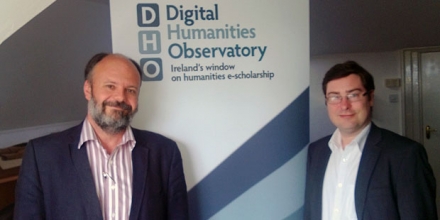
DHO staff are drawn from divergent expertise throughout the digital humanities. Each bring their own unique interests, specialities and passion to the the HSIS initiative. Collectively, the DHO provides support across the entire spectrum of the digital humanities.
Director, Susan Schreibman
Dr Schreibman joined the DHO from the University of Maryland, where she was Assistant Dean and Head of Digital Collections and Research. She has previously served as Assistant Director of the Maryland Institute for Technology in the Humanities, and Professor of Professional and Technical Communication at the New Jersey Institute of Technology.
Dr Schreibman has an MA from the University of Pennsylvania in English and Creative Writing and an MA in Anglo-Irish Literature and Drama from University College Dublin (UCD). She received her PhD from UCD. She was also the holder of a prestigious Newman Postdoctoral Fellowship where she began The MacGreevy Archive.
She is co-editor of A Companion to Digital Humanities (Blackwell 2004) and A Companion to Digital Literary Studies (Blackwell 2007). She is also the Series Co-Editor of Topics in the Digital Humanities (U. of Illinois Press). She is the Editor-in-Chief of Journal of the Text Encoding Initiative, the official journal of the TEI Consortium.
She is the principal developer of The Versioning Machine and is the founding editor and principal developer of Irish Resources in the Humanities. Dr Schreibman is the Vice Chair of the Text Encoding Initiative (TEI) Consortium, on the Executive of the Association of Computers in the Humanities, and the Modern Language Association’s Committee on Scholarly Editions.
Dr Schreibman’s fields of expertise are textual editing, especially as it is applied to the newer technologies, TEI text encoding, project management for digital humanities projects, and Irish modernism.
Contact: s [dot] schreibman [at] dho [dot] ie
IT Projects Manager, Niall O'Leary

Niall O'Leary is IT Projects Manager at the Digital Humanities Observatory. A graduate of University College Dublin's Masters in Film Studies programme, Niall was a scriptwriter in the audiovisual industry for several years. Building on his knowledge of digital media, he then participated in Trinity College Dublin's Masters in Multimedia Systems. Initially this turned his attention to writing articles on IT, creating online stories and scripting online games. However, from writing on IT he gradually became more involved in developing it, becoming Web Development Specialist at Dublin City University. During his time at DCU, he created many of the online university systems, such as student portals and online results, while also maintaining its website and advising on best practice. Somehow he also found time to teach, lecturing in Web Technologies, programming, and, maintaining his interest in film, screenwriting.
Contact: n [dot] oleary [at] dho [dot] ie
Web Developer, Paolo Battino
Paolo Battino is a web developer with the Digital Humanities Observatory. His specialisation is in human factors and human-computer interaction. He has worked as human factor expert in international Air Traffic Control research projects within the european agency Eurocontrol. He was in charge of conducting experiments to test novel procedures and radar visual tools to increase safety and capacity in air traffic over Europe. His most recent experience involved the design and development of web-based Graphic Information Systems to the UNESCO-funded rehabilitation of Bethlehem area, in Palestine. The tools developed by his team allow architects, city council staff members and citizens to access crucial information about local regulation and urban planning. Paolo Battino holds a BAV in Communication and Graphic Design from Laval University (Québec City, Canada) and an MS in Human-Computer Interaction from University of Siena (Italy).
Contact: p [dot] battino [at] dho [dot] ie
Digital Humanities Specialist, K. Faith Lawrence

Faith Lawrence is a digital humanities specialist with the Digital
Humanities Observatory. She did her first degree in ancient history
with a special interest in comparative mythology. Progressing sideways she completed a masters in archaeological science (computing) before finding herself in a computer science department researching online communities, narrative and the semantic web. Her doctorate looked at emergent semantic and web 2.0 technologies through the case study of online fiction archives and author communities. Her most recent projects include Electronic Visualisation of C19 French literary-scientific texts: Flaubert's Tentation de saint Antoine.
Contact: f [dot] lawrence [at] dho [dot] ie
Digital Humanities Specialist, Shawn Day

Shawn Day is a Digital Humanities Specialist with the DHO. Shawn is affiliated with the History Department at McMaster University (Canada) where he is completing a PhD specializing in the social and economic circumstances of the nineteenth century retail liquor trade. He applies digital, spatial and social network analysis to the study of the relationships between credit, respectability, and maintaining order in the Victorian community. His most recent articles have examined the social dimensions of the Victorian public mental hospital. Using GIS and statistical modeling tools, these illuminate the significant rural component of the urban asylum and raises new questions surrounding the foreign-born who find themselves confined to the institution. Shawn is involved in a number of successful and innovative digital humanities projects throughout Canada. Most recently he has worked with large manuscript census databases in the 1871/1891 census project (University of Guelph). He is a team member of the national TAPoR text analysis portal project and the Network for Canadian History and the Environment (NiCHE).
Prior to undertaking the PhD, Shawn spent a number of years in the private technology sector where he founded a number of businesses and served in marketing, research and development management roles.
Contact: s [dot] day [at] dho [dot] ie
Digital Humanities Specialist, Randall Cream

Dr. Randall Cream joins the DHO from the University of South Carolina, where he was the Associate Director of the Center for Digital Humanities at South Carolina and Associate Director for Technology of the University's First Year English programme. Randall trained first in Literature and then in Philosophy before taking a Ph.D. in Enlightenment and 18th Century studies at the University of Connecticut. His NEH-funded Post Doctoral Fellowship in Digital Humanities served as an incubator for a wide array of successful grant-funded projects, with Dr. Cream serving as Principal Investigator or Co-PI on several ongoing projects, most notably the Sapheos Digital Collation initiative. At the DHO, Dr Cream helps us thread the needle between well-structured data, serendipitous content discovery, and user-centered information organization as he takes on aspects of Metadata Manager and DH Specialist.
Contact: r [dot] cream [at] dho [dot] ie
Programme Manager, Katie McCadden

Katie McCadden serves as Programme Manager at the Digital Humanities Observatory. An experienced events manager with extensive connections throughout the not-for-profit and NGO community, Katie McCadden developed and delivered institutes for educators from around the world at Harvard College before moving to Ireland to work as a Project Coordinator and Assistant Editor in the publishing sector. Trained in Communications and French, Katie studied at the Sorbonne in Paris before completing a post-graduate degree in Public Relations and Event Management with the Fitzwilliam Institute, Dublin.
Contact: k [dot] mccadden [at] dho [dot] ie